artists' books the printing press
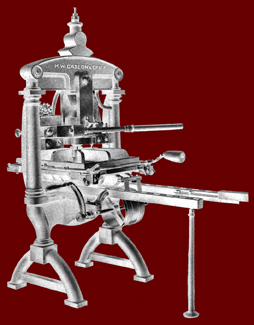
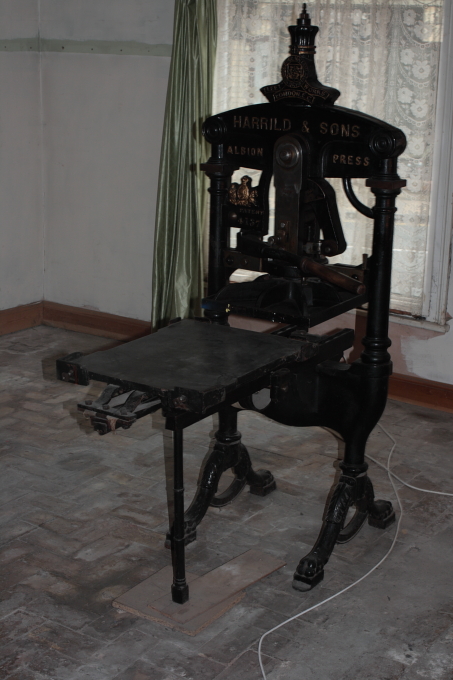
Another manufacturer of the Albion press was Harrild and Sons of London (right).
Note the coat of arms in gold, this was fake and used to give the product an element of authenticity.
photographs copyright © Arvon Wellen 2010
photographs copyright © Arvon Wellen 2010
|
|
|
|
|
|
the printing press
|
|
|
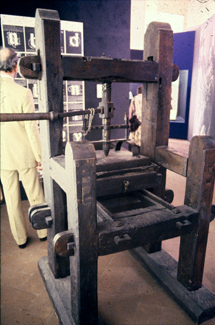 |
Printing Press about 1550, Florence
This wooden press is similar to those used a century before and therefore it is possible that this is similar to the press used by Gutenberg (c. 1400 - 1468).
|
|
(below) Earl Stanhope invented the iron press in 1800
|
|
 |
|
The iron press increased the speed of the process as well as the quality of the print.
The problem for the printer who used the wooden press was that the "platen" was quite small and so, in order to print a double page, the press would need to be pulled twice. The introduction of the Stanhope press, with it's much larger platen and bed, allowed the printer to print the two pages at once.
|
|
 |
|
|
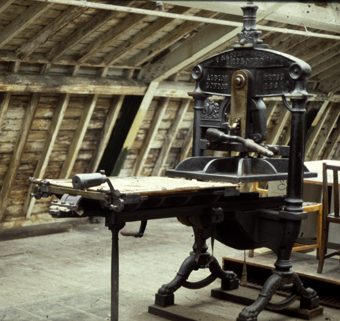
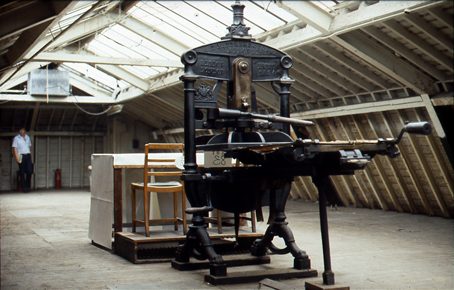
Albion Press; London late 19th century
The photograph was taken at an auction in London in the 1970s. The location is a printer's shop containing letterpress equipment and type and probably looking very much like it would have done a century previously.
|
|
The Albion press was an improvement on the Stanhope. It was invented by Mr. Hopkinson one half of the firm Hopkinson and Cope in 1824. These presses were the workhorses of the printing trade until lithographic presses replaced them. They were exported all over the world.
|
|
 |
|
|
 |
|
 |
|
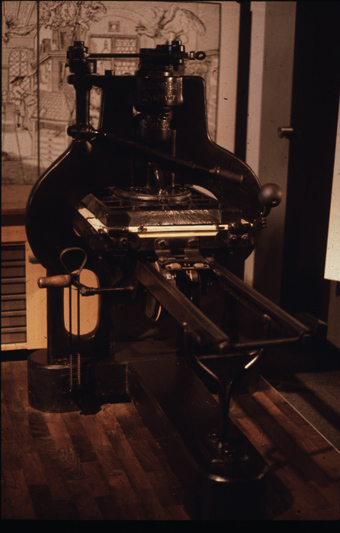
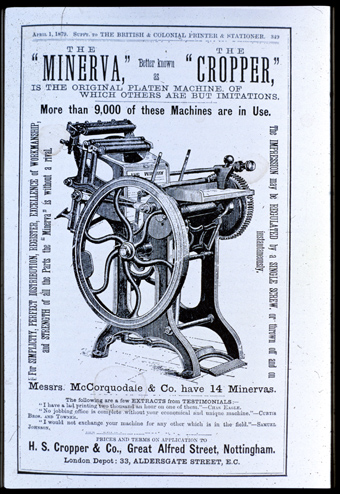
The Cropper was a self inking press used extensively by "jobbing" printers. Some are still in use today.
Each time the treddle opened up the "clam" shape of the platen and the bed the inking rollers would pass over a circular inking slab. At this point paper would be added to the vertical bed. On the return movement, powered by the treddle, the rollers would ink up the type. The final movement compressed the paper against the type.
Once the print had been taken the "clam" would be opened, the paper retrieved and the whole process would start again.
|
|
|
|
|
|
|
|
|
|
|
|