My first introduction to the artist's book was through the influence of Rigby Graham in Leicester where I was one of his students. His enthusiasm drove me to find out more about the process of printing and I ended up as a trainee printer / designer in a small print firm near the city of London.
Despite the long hours sustained by extra strong coffee, that would melt a spoon, I did learn to set type by hand and mind a machine churning out endless brochures that I may have contributed to in some way with text, photographs or illustrations. My fine art background could only sustain this repetitive mass production ethos for so long and, besides it was books that I was interested in, not leaflets and magazines.
While my interest in book making was influenced by the private press tradition in Britain my real interest was in books made by artists, thus, I did not extend my own work further than making experimental books. This developed further through my teaching at Chelsea School of Art where I taught mixed groups of fine art and graphics students. Here we were able to utilise a wide range of media and techniques using printmaking processes, wood and lead type, photography etc. Support came from other staff at Chelsea, such as Susan Einzig and from the book collector and enthusiast Barry Marks.
"The Book", which drew together students from various disciplines also became a centrepiece of my teaching at Anglia Ruskin University. Here we were able to widen the concept of the book to include sequential images such as slide presentation and video. With support from Bobi Booth, Rose Rands and Irene Wise "the Book" became a major part of the programme.
My interest in computers first started in about 1980, though the major problem then was that I had to write code to draw even simple geometric images. All that changed and it was soon evident that computer generated images and text would be a way forward and a means towards greater freedom in the making of books.
I am well aware that the purists in the tradition of fine books and the private press wish to continue that tradition with type set by hand and, while I have committed a substantial part of this site to provide information within that tradition, this is not my main personal interest.
It seems to me that the concept of "the book" has the potential to be an important vehicle for artistic expression and what this means specifically is that it is a means of bringing together two or more disciplines, such as printmaking and writing, or photography and story telling in a way that no other medium, apart from movie making, can do in quite the same way; but then there is no reason not to see the movie as an extension of the book.
Arvon Wellen 2006 © copyright Arvon Wellen 2006 & 2011
|
|
|
THE ARAGO PRESS
Although I have been making books, mainly in collaboration with other people, for many years they were always projects about ideas; these often united text with image. This collaboration took place with students at Chelsea School of Art, London, over a period of eight years. There followed a period at Anglia Ruskin University, Cambridge when the "Book" was integrated into the art and design programme.
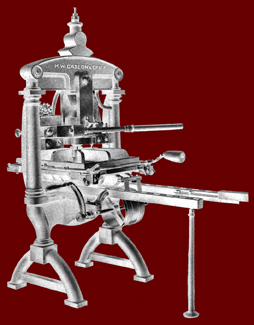
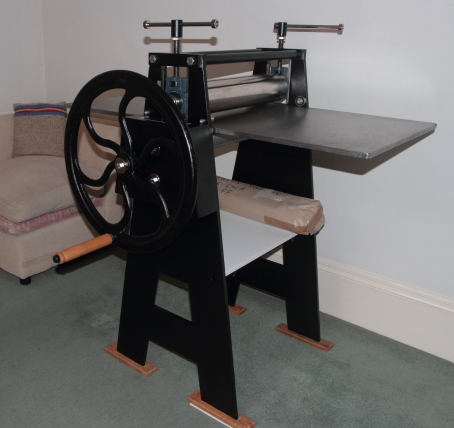
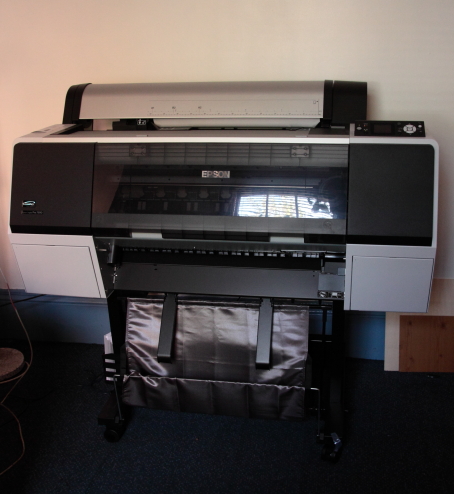
All books and other printed material are produced through a mixture of digital and other techniques, including relief printing, inaglio and lithography. The press is equipped with two Albion relief presses and two etching presses. We also hold a quantity of wood and metal type. For digital printing we are equipped with an Epson Stylus Pro 4800 and an Epson 7890 inkjet printer using archival quality ink.
We use a variety of papers but we favour Somerset Enhanced Velvet and Arches Aquarelle cold press for digital printing and Rives BFK for relief printing.
|
|